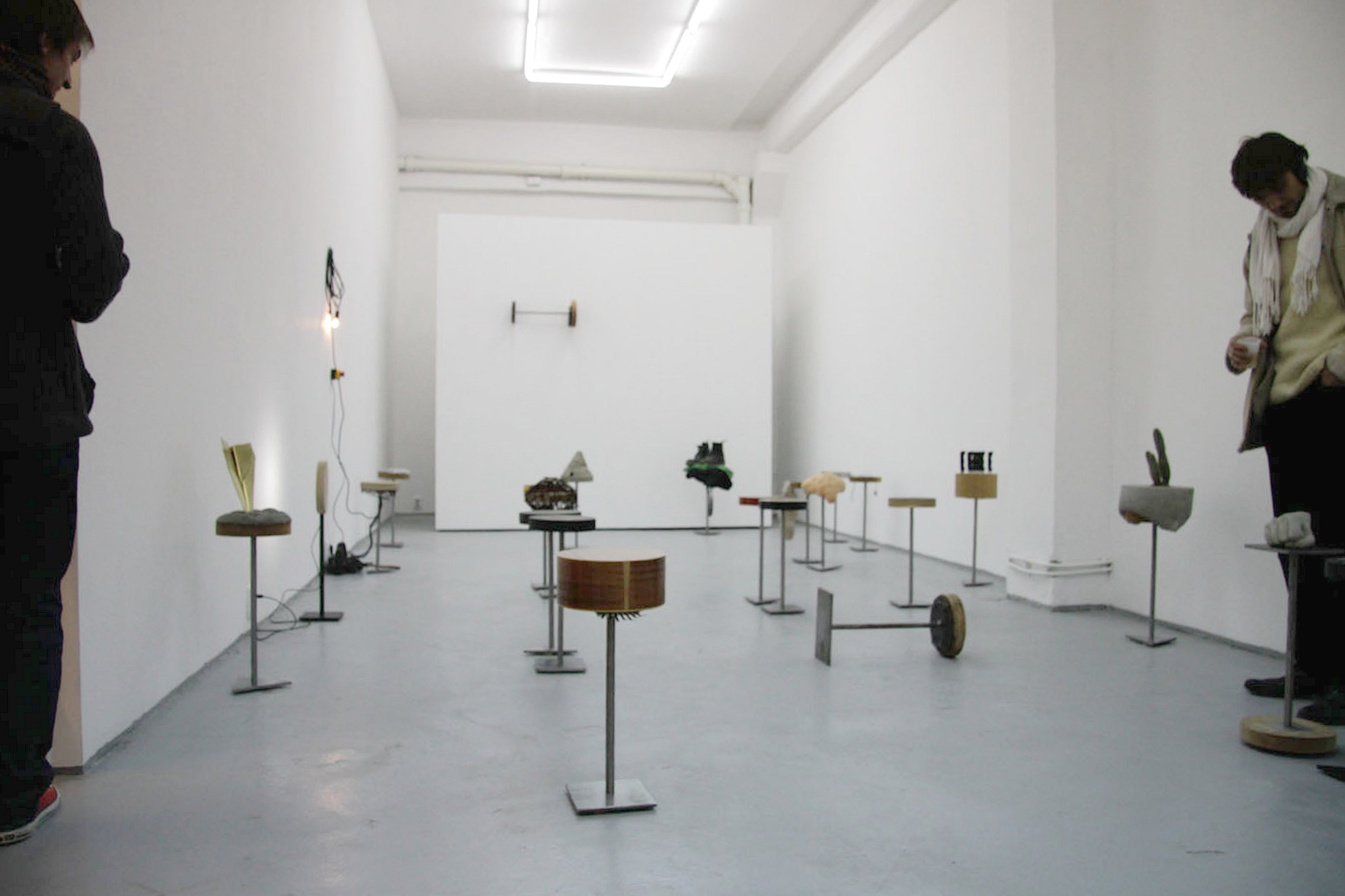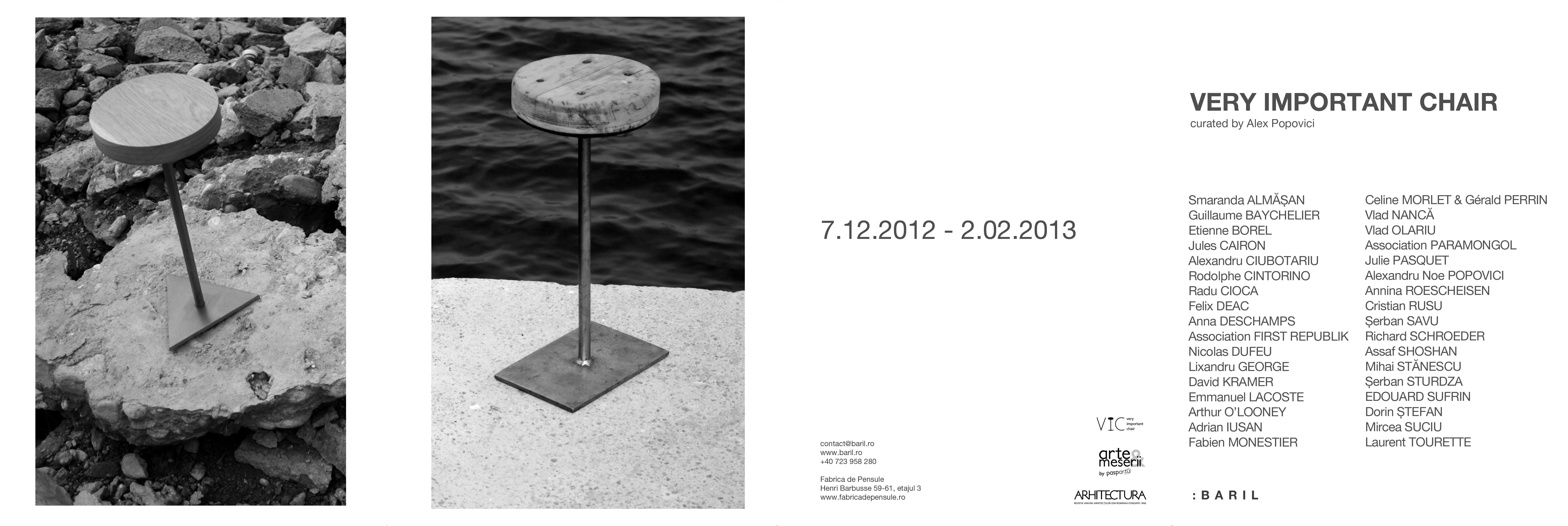
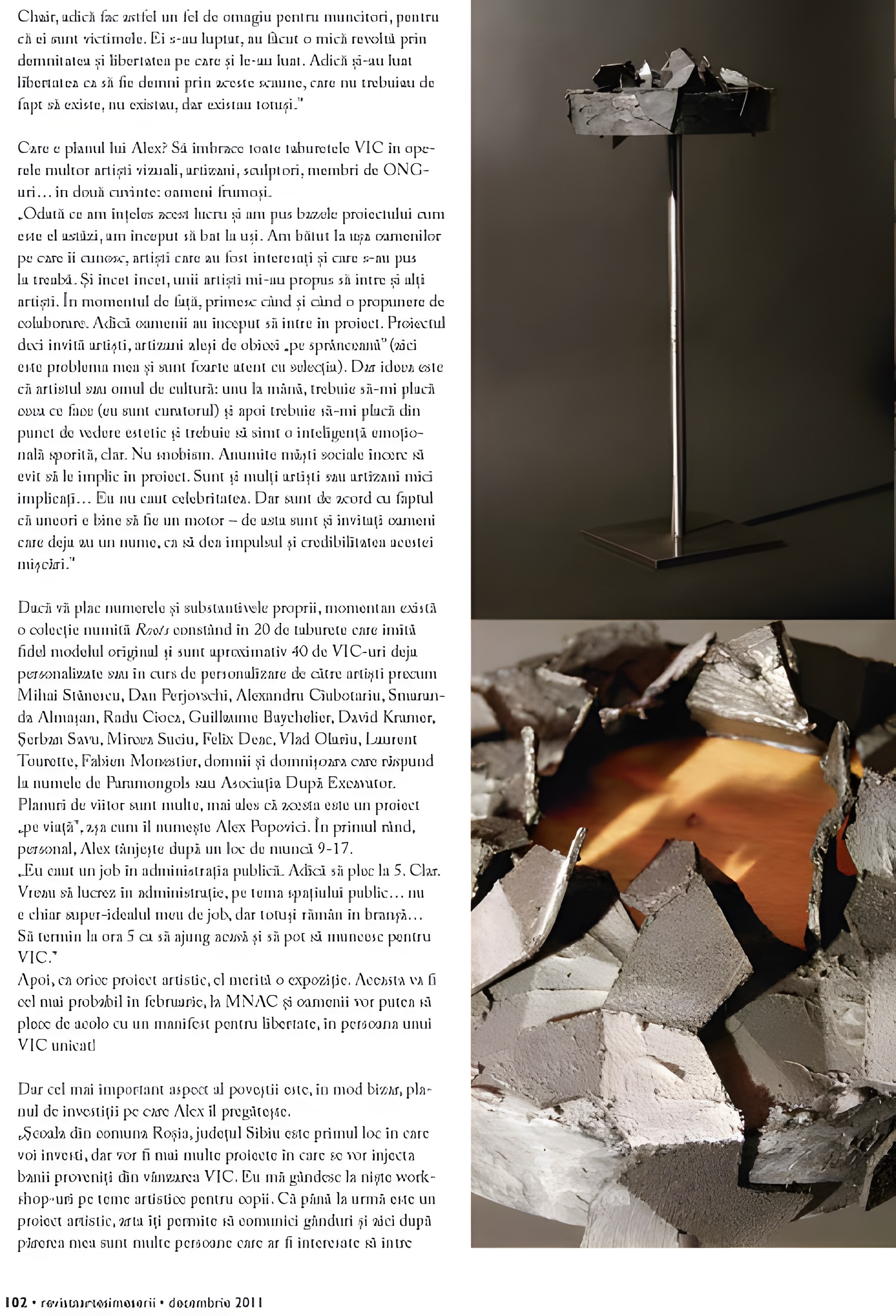
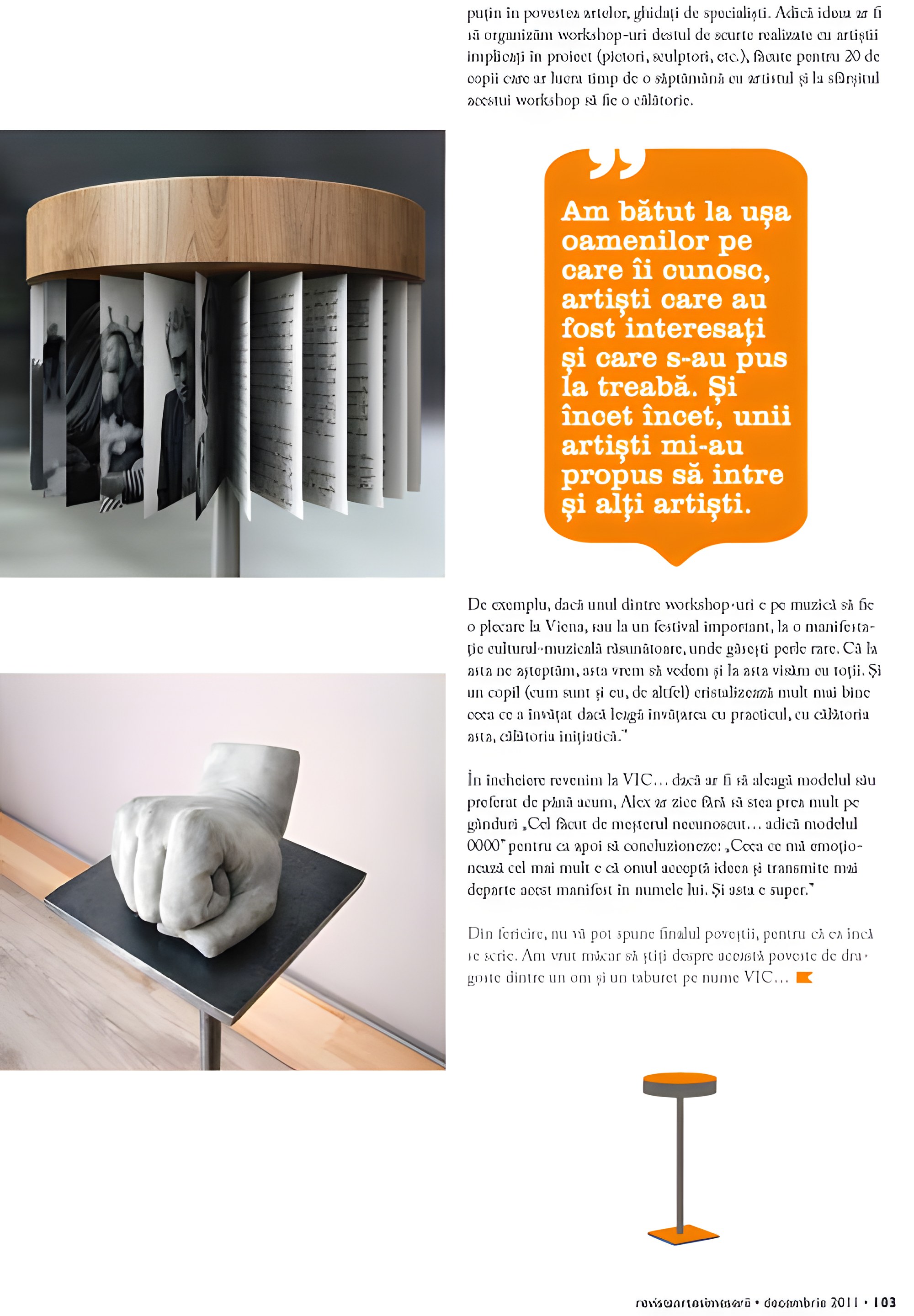
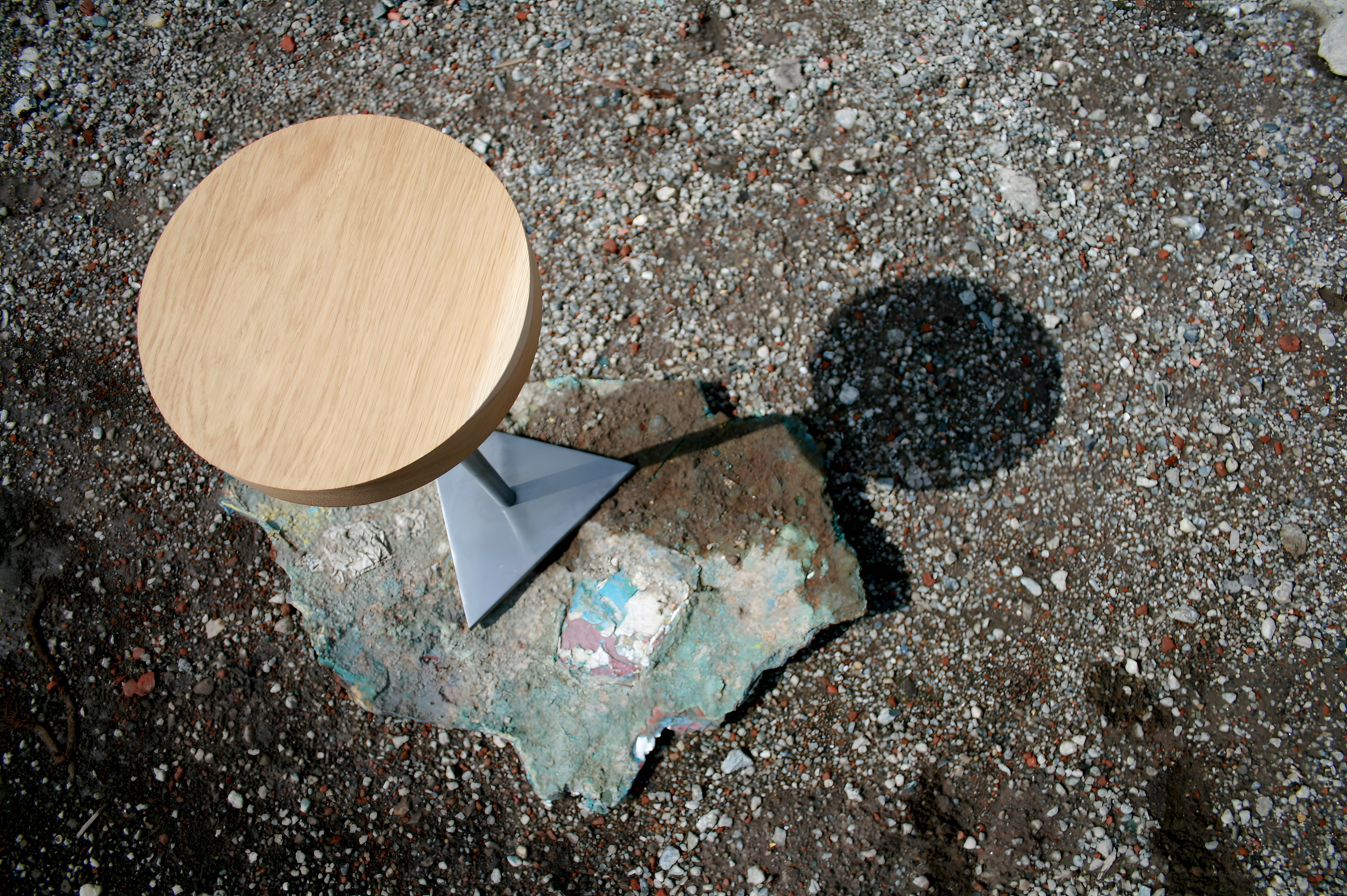

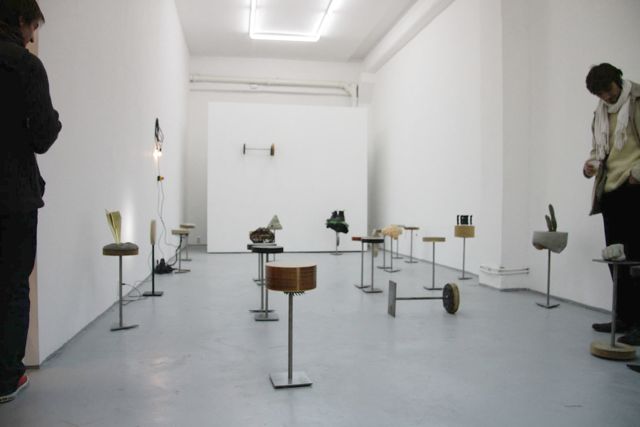
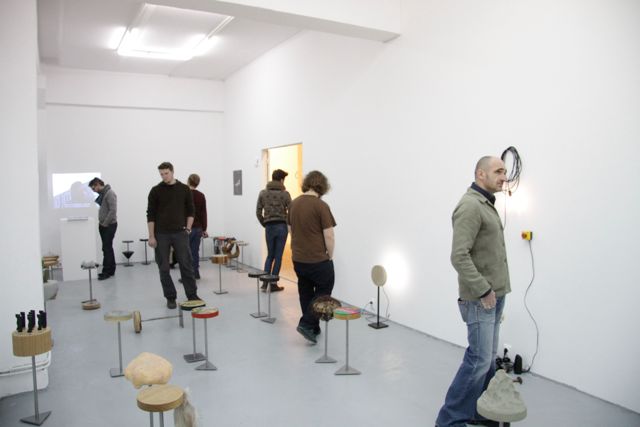
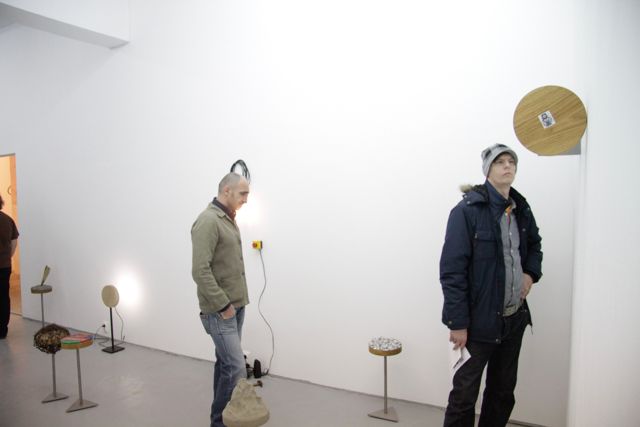
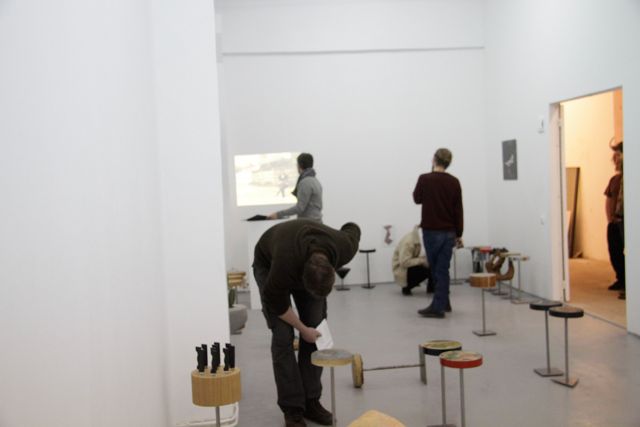
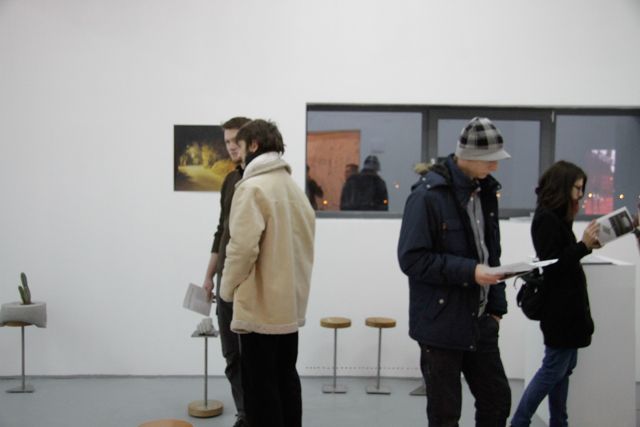
VIC tells the story of the accommodation to a double hubris, one that Alexandru Popovici, the project initiator, tries to overcome, by exhibiting, paradoxically, both the weapon of irony and the cure of compassion.
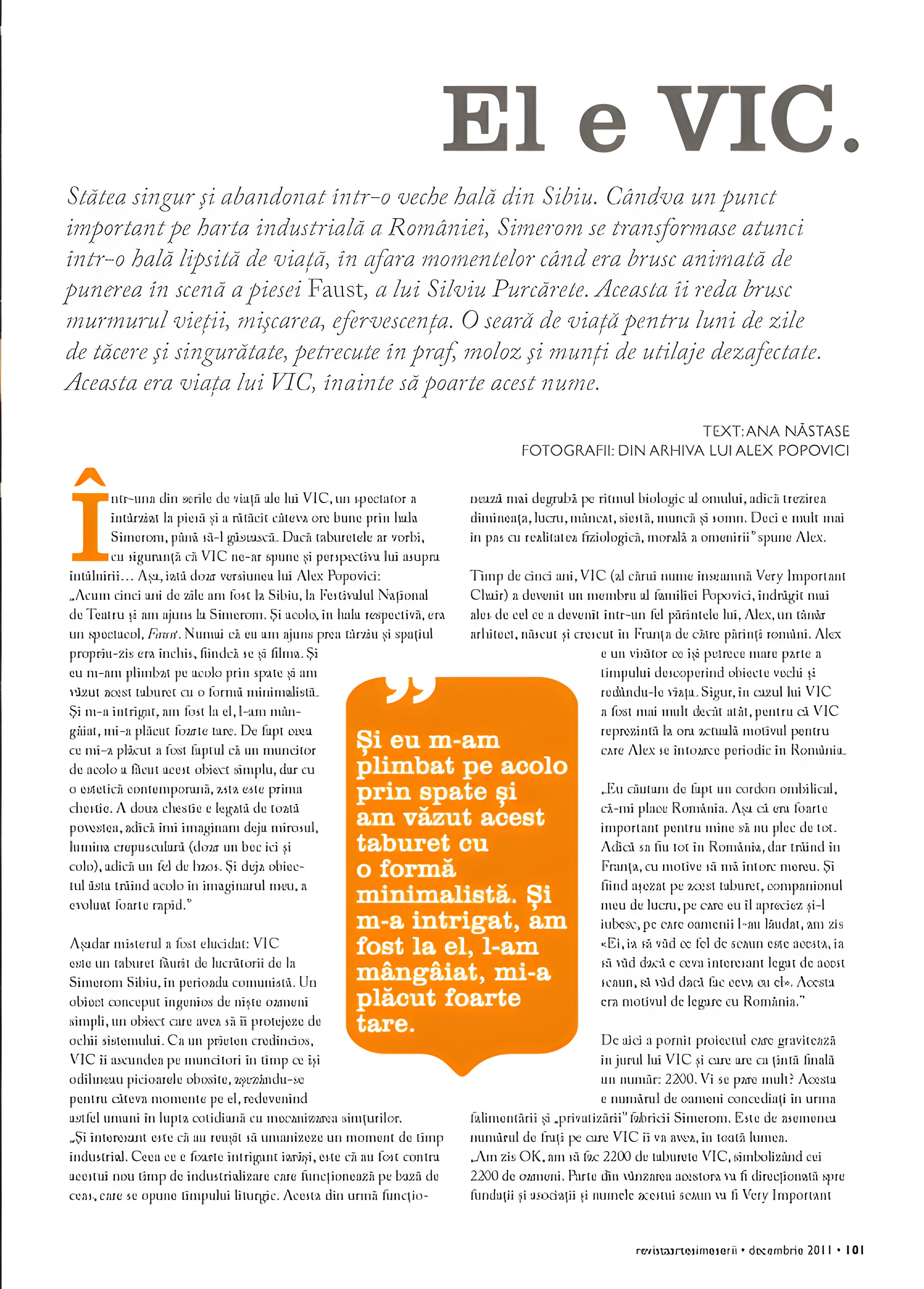
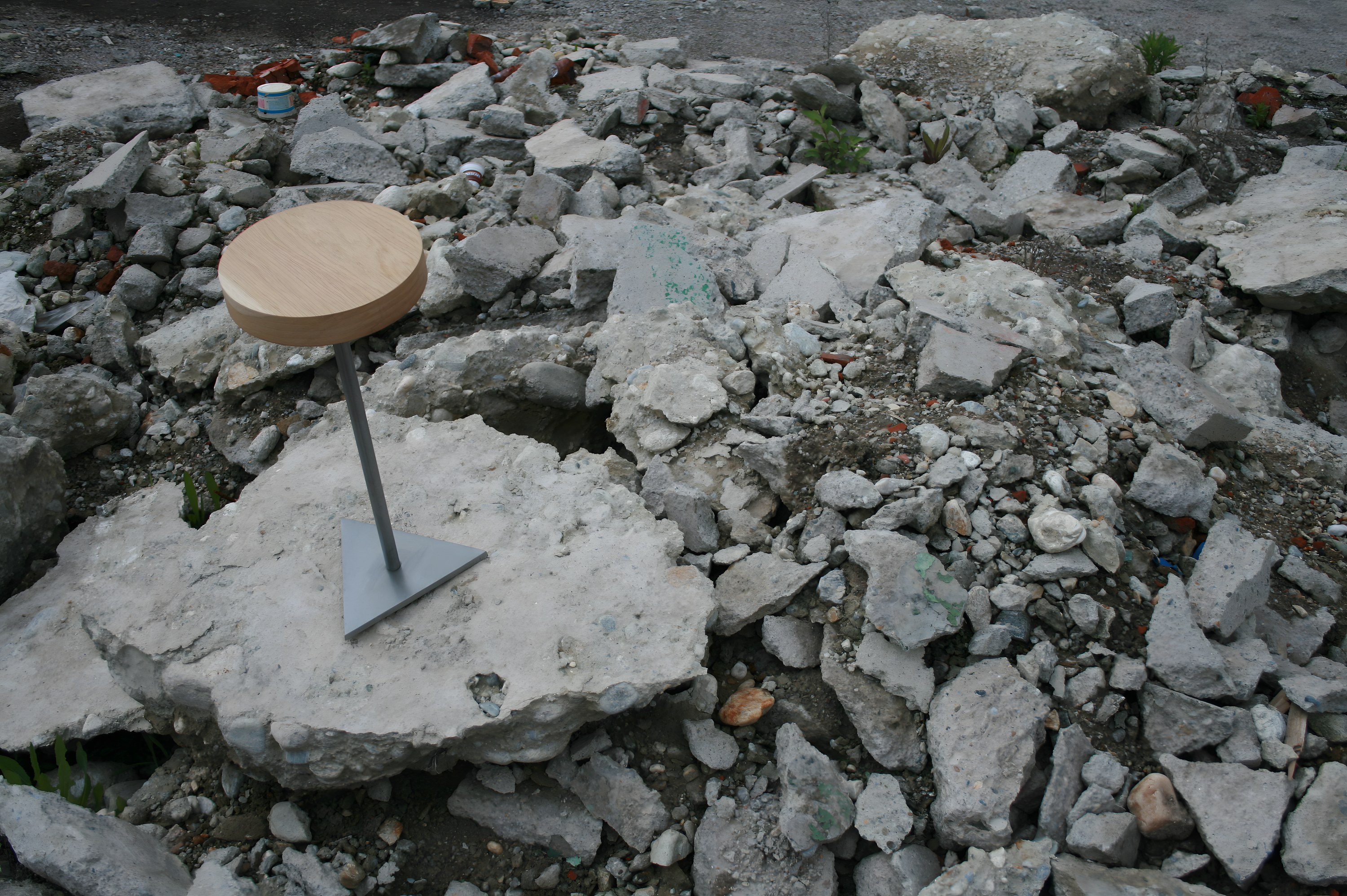
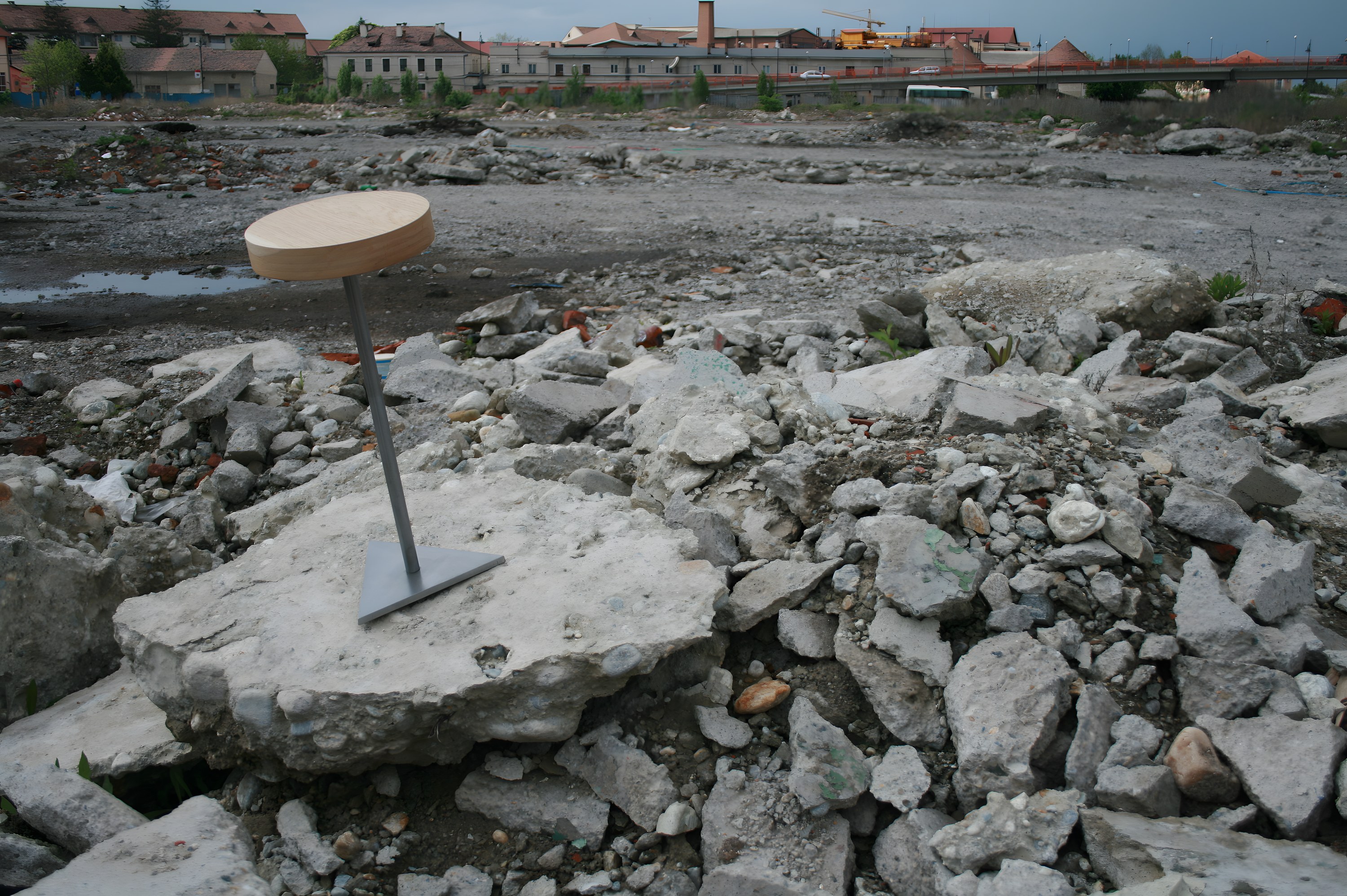
The first hubris, the opening hubris, is a Stakhanovite one, commited by the overstandardized and supervised proletary. He is forbidden the elementary gesture of resting on a chair and thus manages, in a confortable and subversive way, to produce a chair himself, more precisely a stool that he uses during working hours. Historically, this is communism, during the presidency of Ceausescu, and the place is the Simerom factory in Sibiu, no longer functional today.
The second hubris is a faustic one: a stool of those proletarians is rediscovered after some years have passed, by a viewer who arrived late at a Faust performance in a hall of the former Simerom factory. The viewer needed a minimum of comfort to watch the play, so he wandered through the deserted factory until he discovered VIC.
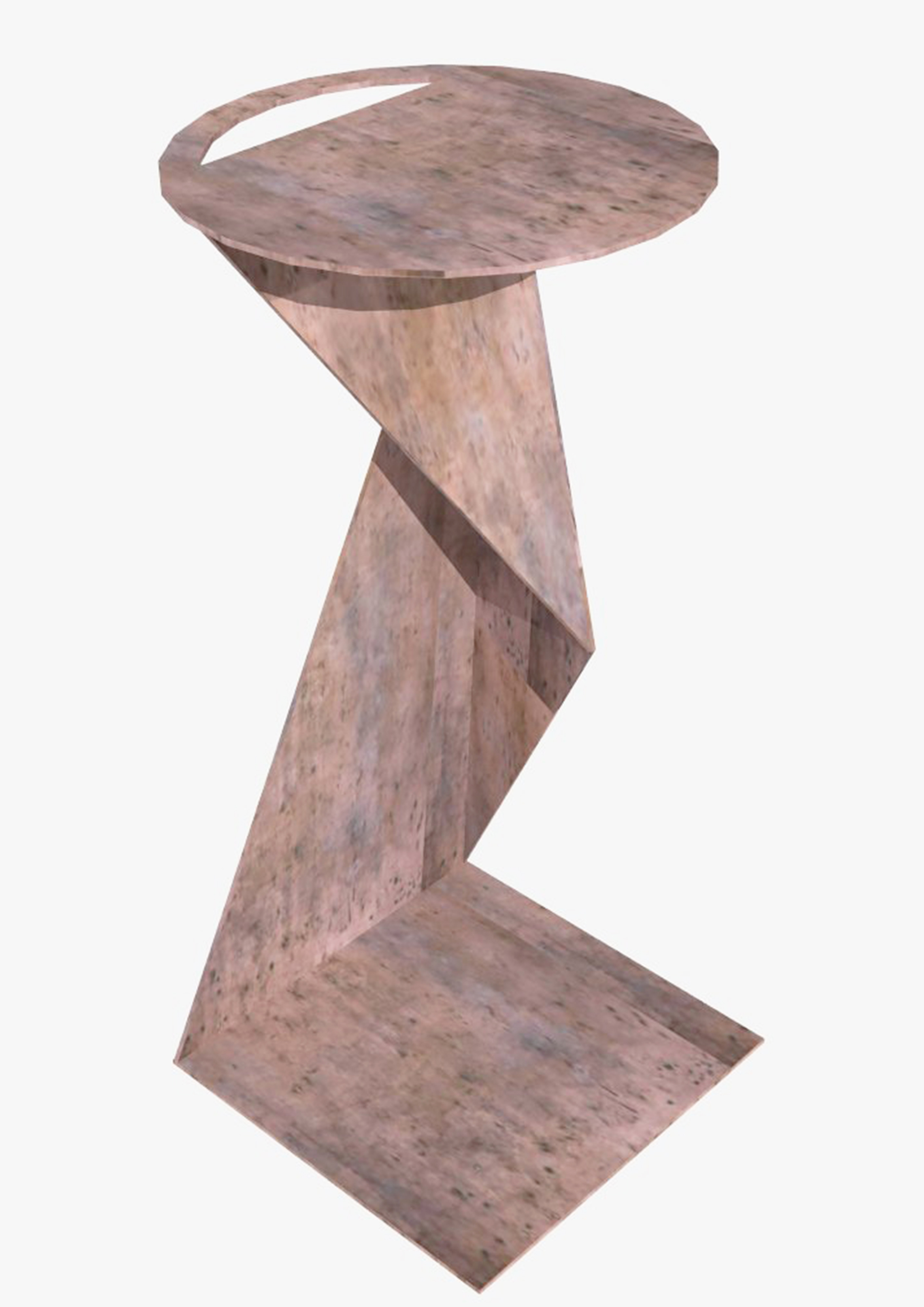
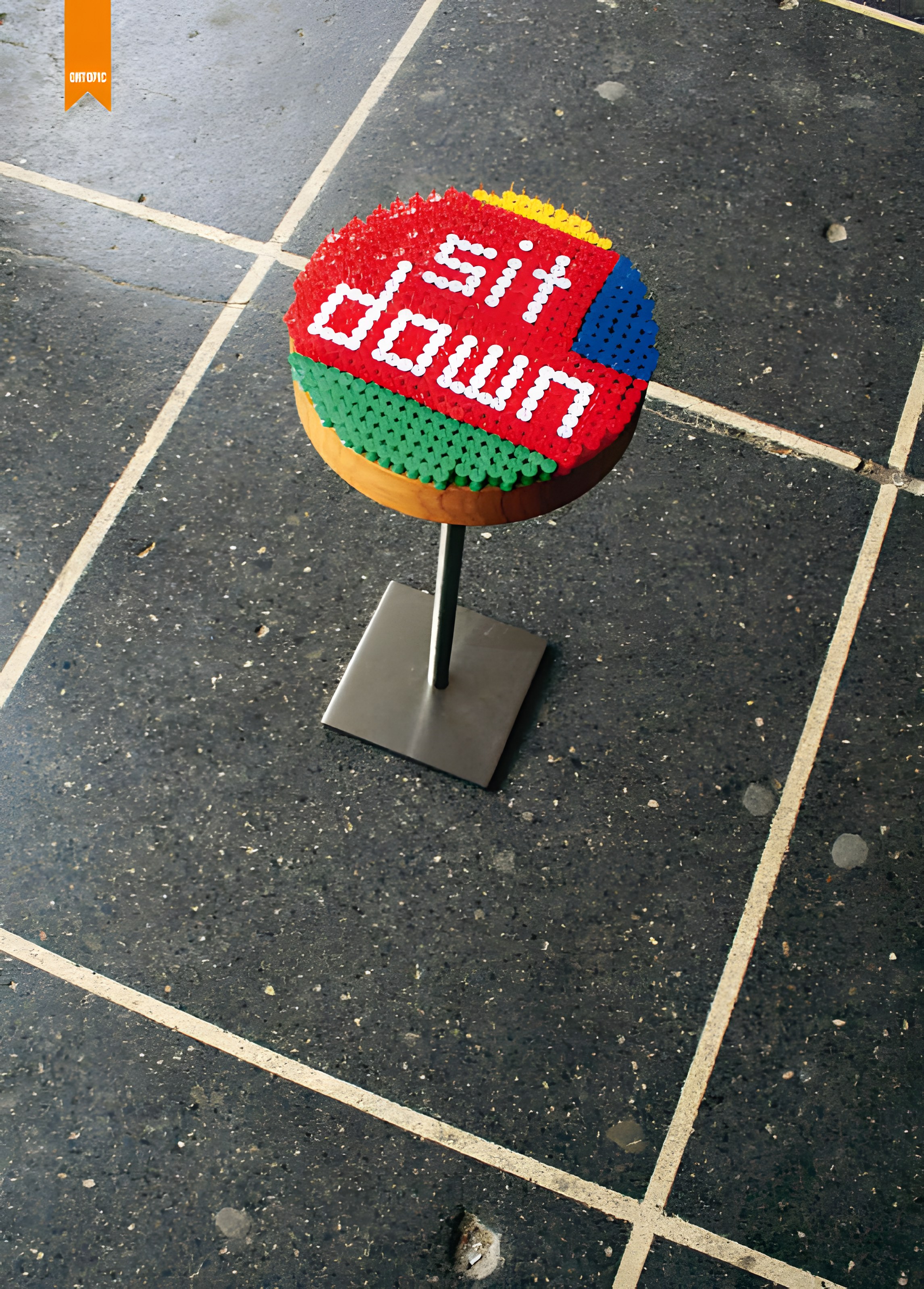
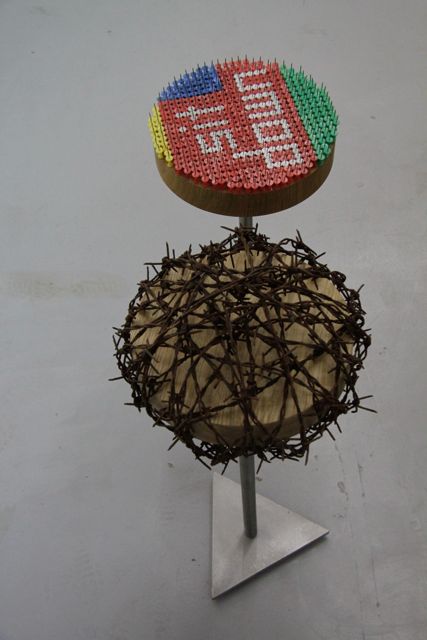
Alexandru Popovici takes the familiar object and dares other artists to multiply it. Hence the irony: an object that becomes a protest towards the standardization, mass production and inhuman industrialization needs to be multiplied in 2200 pieces. But to multiply is not to copy, and this is where compassion intervenes: we have 2200 stools because after the Revolution 2200 workers of the former factory were left unemployed.
Alexandru Popovici says: „I said, ok, let’s make 2200 VIC stools, because 2200 unemployed people came out of the former Simerom factory. Part of the money will be given to foundations and associations. There are a lot of small artists and handicraftsmen involved... I don’t seek to be famous. But I agree that sometimes you need an engine, and this is why we invited people who are already well-known, to give impulse and make this movement credible.”
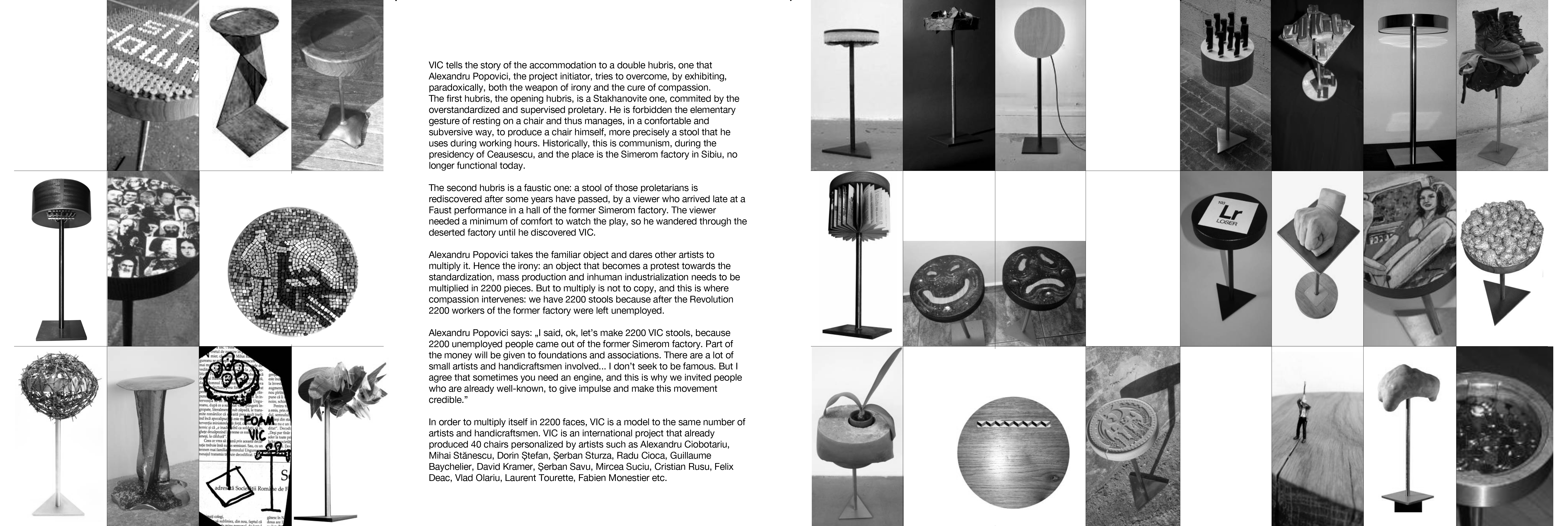
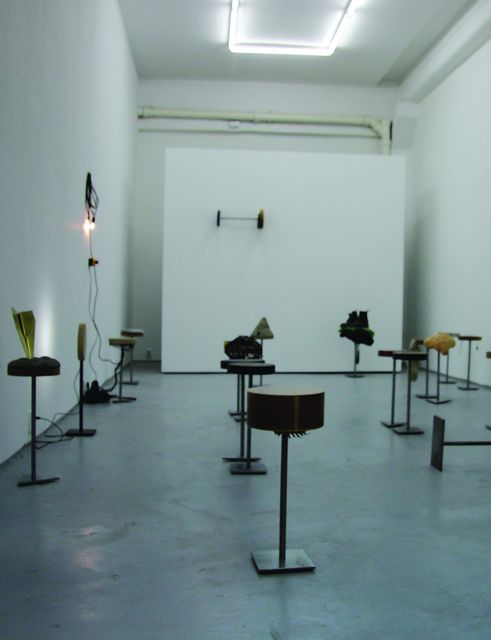
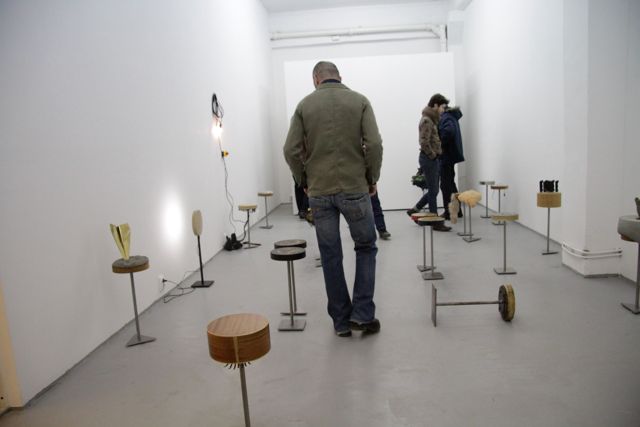
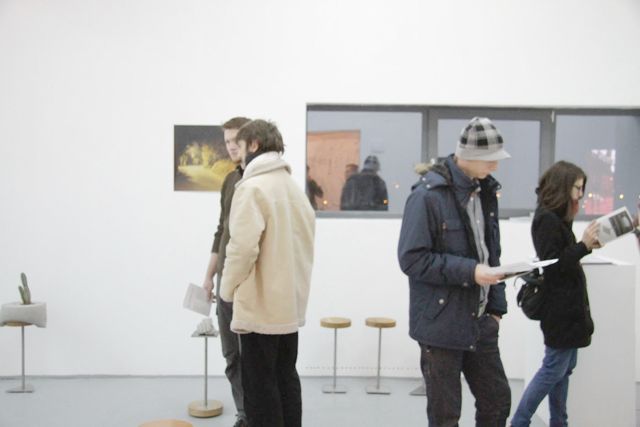
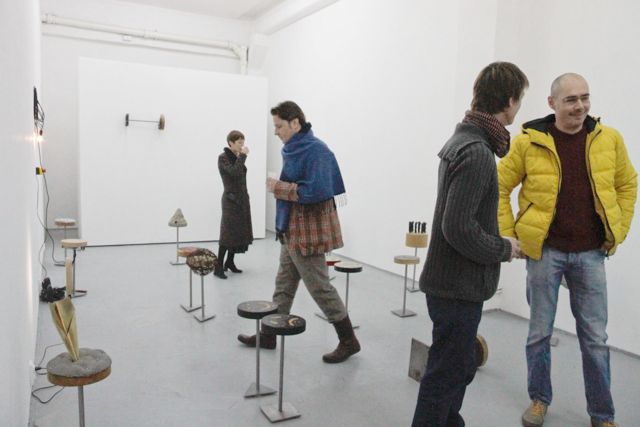
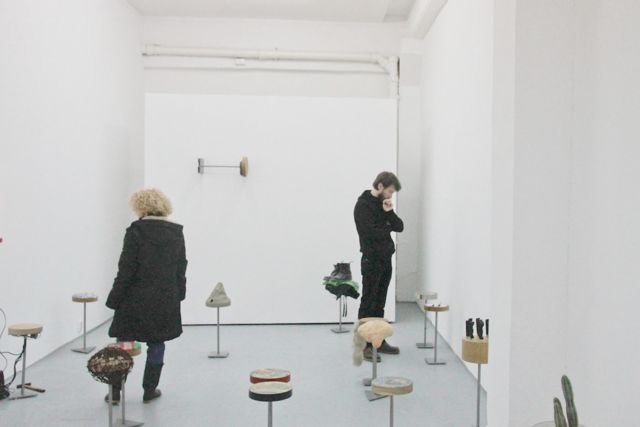
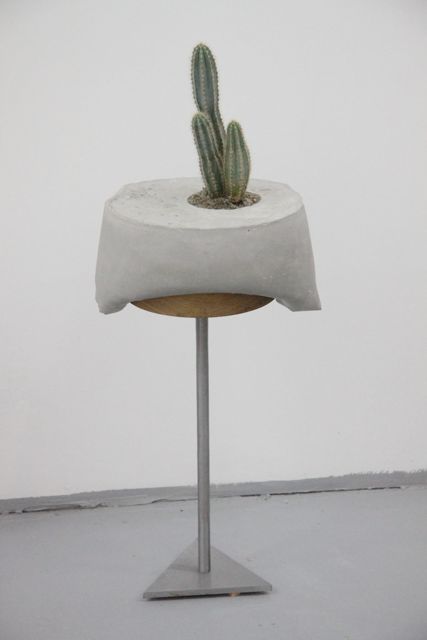
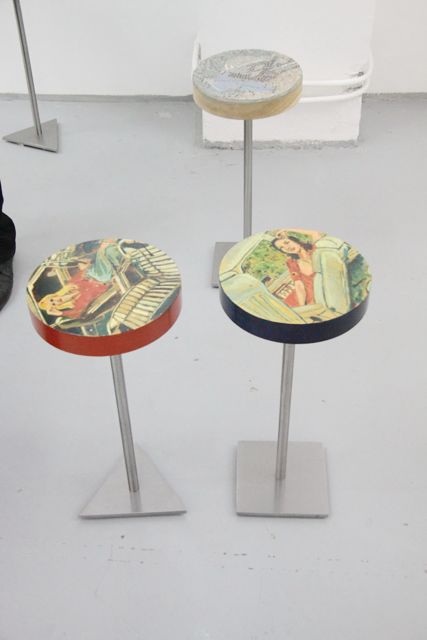
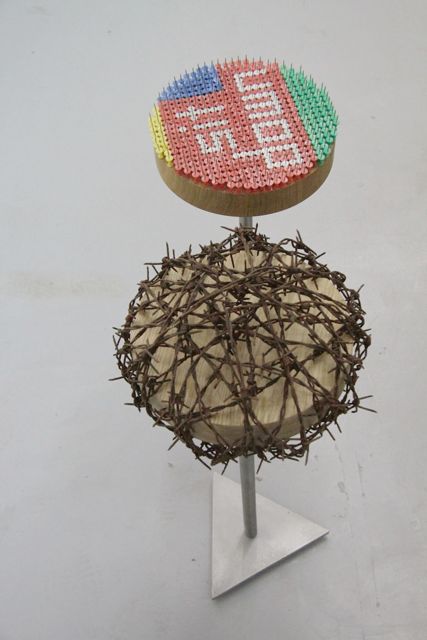
In order to multiply itself in 2200 faces, VIC is a model to the same number of artists and handicraftsmen. VIC is an international project that already produced 40 chairs personalized by artists such as Dan Perjovshi, Alexandru Ciobotariu, Mihai Stănescu, Dorin Ștefan, Șerban Sturza, Radu Cioca, Guillaume Baychelier, David Kramer, Şerban Savu, Mircea Suciu, Cristian Rusu, Felix Deac, Vlad Olariu, Laurent Tourette, Fabien Monestier etc.
VIC spune povestea acomodării la un dublu hybris, pe care Alexandru Popovici, inițiatorul proiectului,încearcă să-l depășească punând la bătaie, în mod paradoxal, atât arma ironiei, cât și leacul compasiunii.
Primul hybris - inaugural - este cel stahanovist, al proletarului supranormat și supravegheat. Proletar care, fiindu-i interzis gestul elementar al repausului - șezutul pe un scaun, reușește într-un mod confortabil și subversiv să-și bricoleze un taburet de care să se servească în timpul programului de lucru. Istoric, ne aflăm în comunism, anii ceaușismului, iar locul e fabrica Simerom din Sibiu, astăzi închisă.
Al doilea hybris este cel faustic: un taburet al acelor proletari e redescoperit, după ani, de către un spectator întârziat la o reprezentaţie cu Faust găzduită de o hală a fostului Simerom. Spectatorul avea nevoie de un minim confort pentru a urmări Faustul, așa că a rătăcit prin fabrica pustie până l-a descoperit pe VIC.
Alexandru Popovici preia obiectul familiar și provoacă alți artiști să-l multiplice. De aici ironia: un obiect-protest faţă de normare, înseriere și industrializare dezumanizantă trebuie multiplicat în 2 200 de exemplare. Multiplicarea nu e copiere, însă, iar aici intervine compasiunea: avem 2 200 de scaune, pentru că fostul Simarom a produs, post-revoluționar, 2 200 de șomeri. Spune Alexandru Popovici: "Am zis ok, am să fac 2 200 de taburete VIC, simbolizând cei 2 200 de oameni. Parte din vânzarea acestora va fi direcționată spre fundații și asociații. Sunt și mulți artiști sau artizani mici implicați… Eu nu caut celebritatea. Dar sunt de acord cu faptul că uneori e bine să fie un motor – de asta sunt și invitați oameni care deja au un nume, ca să dea impulsul și credibilitatea acestei mișcări."
Pentru a se multiplica în 2 200 de chipuri, VIC servește drept model pentru un număr (poate) la fel de mare. De artişti sau meşeteșugari. VIC este un proiect internațional care a produs deja aproape 40 de scaune personalizate de artiști precum Alexandru Ciobotariu, Mihai Stănescu, Dorin Ștefan, Șerban Sturza, Radu Cioca, Guillaume Baychelier, David Kramer, Șerban Savu, Mircea Suciu, Felix Deac, Vlad Olariu, Laurent Tourette, Fabien Monestier ș.a.
Smaranda Almășan
Antoine Azpitarte
Guillaume Baychelier
Etienne Borel
Jules Cairon
Christophe Chabaud
Alexandru Ciubotariu
Rodolphe Cintorino
Radu Cioca
Felix Deac
Anna Deschamps
Asociația După Escavator
Association First Republik
Nicolas Dufeu
Lixandru George
David Kramer
Emmanuel Lacoste
Arthur O'Looney
Adrian Iusan
Andrei Ivănescu
Fabien Monestier
Celine Morlet & Gérald Perrin
Vlad Nancă
Vlad Olariu
Association Paramongol
Julie Pasquet
Alexandru Noe Popovici
Annina Roescheisen
Cristian Rusu
Șerban Savu
Richard Schroeder
Assaf Shoshan
Mihai Stănescu
Șerban Sturdza
Edouard Sufrin
Dorin Ștefan
Mircea Suciu
Laurent Tourette